
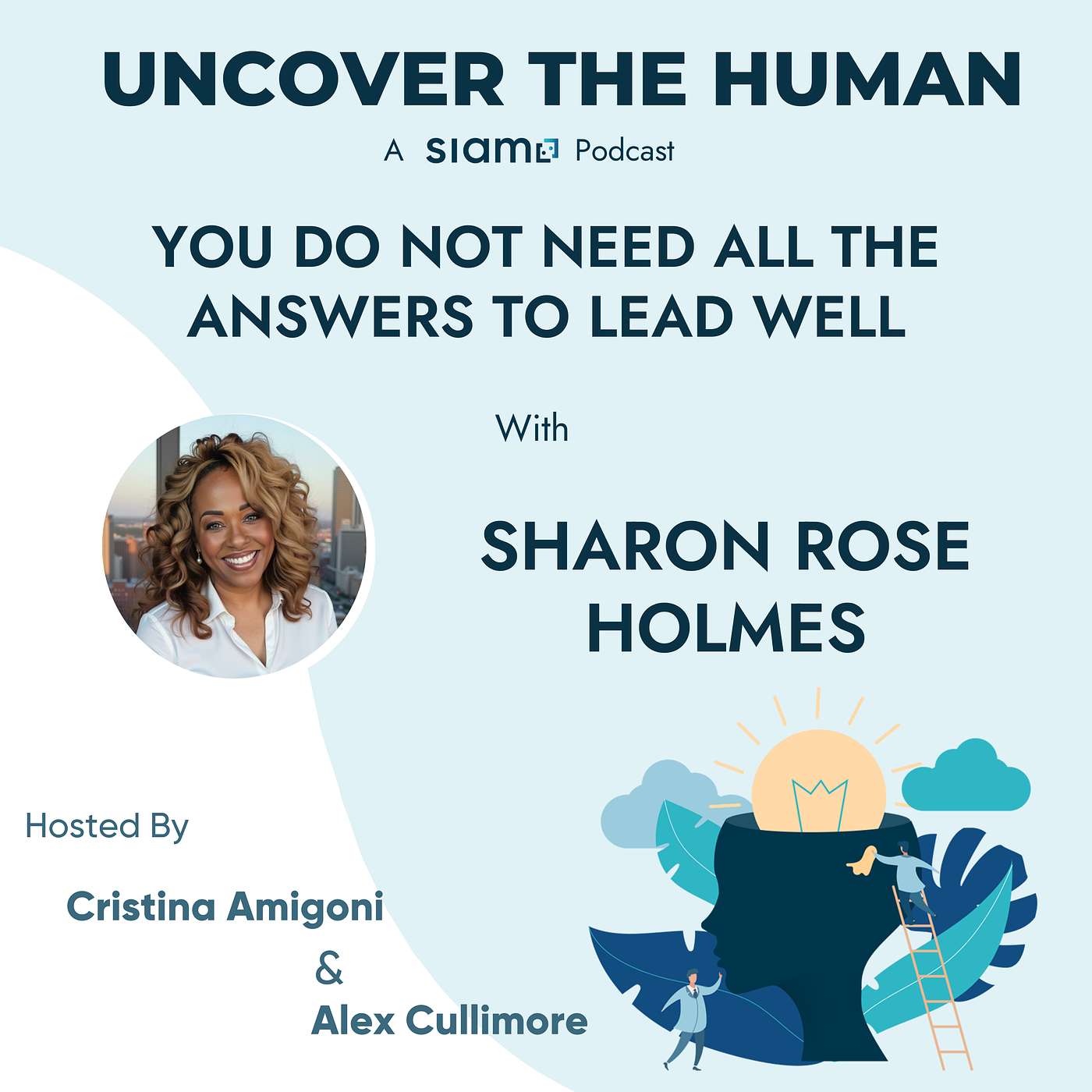
About this episode
In this energizing episode of Uncover the Human, Sharon Holmes shares practical, heartfelt wisdom for anyone navigating leadership, career growth, or change. From stepping into management for the first time to finding your voice in rooms where you feel overlooked, Sharon offers actionable advice on building trust, leading former peers, creating meaningful one-on-ones, and taking ownership of your own development. Her perspective is both deeply human and immediately useful, blending real-world leadership experience with refreshing honesty about setbacks, resilience, and what it means to grow through uncertainty.
This conversation is especially compelling for emerging leaders, ambitious individual contributors, and anyone who has ever felt muted at work. Sharon brings warmth, energy, and sharp insight to topics like sponsorship, feedback, authenticity, and using tools like AI to support—not replace—the human side of leadership. It’s the kind of episode that leaves you with pages of notes, a few mindset shifts, and a stronger belief that leadership is less about having all the answers and more about creating the space for people to thrive.
About the guest

Sharon E. Rose Holmes
Principal | Executive Coach | Human-Centered Leadership Developer
Sharon E. Rose Holmes is a global leadership development executive, executive coach, and master facilitator with more than 25 years of experience helping leaders grow with confidence, clarity, and purpose. She is the Founder and Principal of Rose Ascension Group, a leadership development and executive coaching practice focused on cultivating self-aware, emotionally intelligent, and impactful leaders.
Throughout her career, Sharon has partnered with senior leaders and executive teams across industries including life sciences, manufacturing, energy, technology, financial services, and nonprofit organizations. Her work centers on leadership presence, influence, trust, and culture — helping leaders navigate complexity, lead through change, and create environments where both people and performance thrive.
Known for her warm, engaging, and highly practical style, Sharon blends strategic insight with real-world application and compelling storytelling. Whether coaching executives one-on-one, facilitating leadership cohorts, or advising organizations during transformation, she is deeply committed to uncovering the human side of leadership as the foundation for sustainable impact.
Transcript
Sponsors And Mentors That Matter
SPEAKER_00
Find a sponsor in the company that you can go and talk to. You may be assigned a formal mentor, but I would say find an informal person.
SPEAKER_03
Hello, Christina.
SPEAKER_01
Hello, back-to-back podcast days.
SPEAKER_03
Yeah, yeah, it's a busy one this week, but both excellent conversations. We had a return guest. Now today we have Sharon joining us. Sharon Holmes, who is new to us, or at least new to the podcast, but we've gotten to talk to her a few times. And I think she absolutely lives up to the idea that her middle name might actually be energy.
SPEAKER_01
Yes, yes. She has a lot of energy. She leans into it and it's it's good energy to be around.
SPEAKER_03
Yeah, it's very positive, very building, incredible tips, very specific as well as just easy to understand. So I really appreciate the perspective that Sharon has shared here. It's a fun conversation, and we owe the introduction to Joe Messina. So thanks, Joe.
SPEAKER_01
Yes. Thank you, Joe. Again. Uh hope you listen to this. Yes, but yeah, the tips were wonderful. Like you could build an entire framework just from all our tips, especially emerging leaders, new leaders, or even uh people that have been in the everybody that you know, individual contributors, people that have been in leadership for a while, but they're looking at higher levels. So, yes, lots to learn and take notes on. And we hope you enjoy.
SPEAKER_03
Enjoy.
Meet Sharon And Her Story
SPEAKER_03
Welcome back to another episode of Uncover the Human. Today, Christina and I are joined by our guest, Sharon Rose Holmes. Welcome to the podcast, Sharon.
SPEAKER_00
Thanks. Thank you. I'm so excited to be here. This is great. This is my first podcast. I'm really excited.
SPEAKER_01
Yeah, welcome, Sharon. And we got introduced to you by Joe Messina, who's also been on a podcast.
SPEAKER_00
Yes, I saw. He did a great job. So I don't know if I I'll be able to match him point by point, but thanks, Joe. Thank you, Joe.
SPEAKER_03
Shout out to Joe.
SPEAKER_01
Yeah. I'm pretty sure he listens fairly consistently. And we'll tell him to listen to this one.
SPEAKER_00
That's right. And I'm gonna make sure all my friends listen. So this one will shoot right up.
SPEAKER_03
Well, Shannon, what's your background? What's your story? What brought you here?
SPEAKER_00
I'm gonna talk a little bit about me professionally. And I always like to start with saying, you know, I started my career in sales. And a lot of times, people I now work in sort of the talent and the human space. But usually after talking to me for a little while, people see it, although they don't see it immediately. What I will tell you about my career in sales is I am a talker and I can talk, but I also learned how to really listen deeply. I pride myself in really building trust quickly and trying to understand what motivates people. And I didn't realize at the time how foundational that would become. You know, as I grew, I discovered a real passion for developing and leading others, which led me to earn my master's in management, where I focused on HR and organizational development. And I got that from the COGAT shout out to the Kot School of Business at American University. And I would say from there, I, you know, I intentionally built my career around the human side of performance. So I really began right out of grad school doing some consulting. It wasn't necessarily the plan, but that's how I started doing leadership development consulting and a lot of facilitation. And I worked directly with leaders and teams. And over time, I grew into more strategic, enterprise-level HR and talent leadership roles. I would say across my career, I've had the opportunity to work with a range of organizations, including companies like ThermoFisher,
Resilience After A Career Setback
SPEAKER_00
Scientific, AAK, some of my proudest moments were at FMC and Selenus and Comcast. And through them all, I really helped strengthen leadership capability. I helped build succession pipelines and really navigate large-scale change. And one of the accomplishments, you know, I'm most proud of and I like to do is designing and launching multi-tier leadership and succession frameworks that supported hundreds of leaders globally. So really creating what I would say are clearer pathways for growth, improving bench strength, and helping leaders feel more confident and prepared in moments of transition. Most recently, I served as head of global talent for a small Swedish company, Swedish-based company. And like many leaders right now, I was impacted by a layoff. But I'll tell you that experience has been both grounding and clarifying. As we kind of talked about earlier, I'm currently exploring my next chapter, considering is it a good full-time leadership role? Am I going to do some fractional work? But I would say in between all that, I also launched my consulting practice, Rose Ascension Group, www.roseascension group.com. And it's all centered on helping leaders lead with clarity, confidence, and humanity in really complex environments. So it's a little bit about me.
SPEAKER_01
It's been a wonderful career arc.
SPEAKER_00
Yes, it has been. Yeah, I'm spiritual as well. And so I always say you make plans and God kind of laughs because there's so many different paths that my life has taken that I never thought. But with each one, I feel like I've learned and I've grown and I've evolved and learned each time, including most recently, where I thought I was facing a setback. There's no such thing, really. It feels like there is. And I know people that'll be listening to this be like, Sharon, what are you talking about? You know, I'm in the middle of a setback right now. But it really isn't if you lean into it and you try to listen to what is the learning, right? What am I supposed to get out of this sort of moment of transition and try to kind of grow through it? You'll come out so much stronger on the other side. And it's been proven time and time again. If you even, anyone listening, if you think about any setback that you've had, you've survived it. Look at you. You're still here. You're surviving it. You may not be doing what you thought you were doing, but you're doing what you're supposed to be doing. And that's how I try to also look at it.
SPEAKER_01
Yeah, one of my favorite quotes that I see often is we've gotten through 100% of the tough moments you've ever had.
SPEAKER_00
It's so true. You don't think you're gonna necessarily survive it. When I think about, you know, and I've asked different leaders and different people that I've worked with, you know, what stands out about me. I think you all said it first. A lot of people will say energy, energy. And in fact, my middle name, I can't believe I'm gonna say this on the podcast. My middle name is Elizabeth. And named after my great Aunt Elizabeth. But a lot of people say that E must stand for energy. And I'm glad. I'm like, uh, I don't have a lot of energy, but people think I do, I must be what I get. But I would also say I have a lot of resilience and I try to really lean into that because I try, you know, I get down in the dumps like everyone else. I have down days, I have moments where I'm just like, please, you know, what are you trying to tell me? Right. But again, I try to lean into my strength and kind of pushing through and remembering that, again, as you said, I've survived 100% of all the setbacks, and I've come through stronger. And I'm gonna survive whatever setbacks are ahead of me because that's just how I'm cut and how I'm made. And I remind myself, I stand on the shoulders of really strong women and men that came before me, and I can't let them down, and I can't let myself down.
SPEAKER_03
That makes sense. You mentioned like you you left grad school, you started to focus on the human portion. Do you feel that was something that was just more innate to how you approach things? Is it something you learned
The Bird Analogy For Focus
SPEAKER_03
with experience? We always kind of debate this. How much of it is an innate thing when when you meet people like you who really go human first?
SPEAKER_00
Yeah, you know, I agree with you. It is a healthy debate. I think, yes, you're either born with aspects of it or you're not. But I don't think if you don't feel like you were born with it, that you can't learn it or you can't lean into it. I think we're all born with different levels of it. And it's whatever experiences that you have that will bring out the best of that in you. And so for me, you know, what's funny about grad school, I'll never forget two analogies I was given. One, the first day of grad school, I'll never forget this. One of our lead professors, we were all really busy professionals, and many of us, there were a variety of people at different ages and levels. I had worked about 10 years of my career before I went back. So I was, I felt like I was old, but there were a lot of people who were going back that were older than me, younger Minus. So there was a big mix within our, and it was a cohort-style program that were in our cohort. And he wanted to really center us. And he said, I want you to think about a bird. And you know, you can teach a bird to respond to different sounds. Like, so for example, you can whittle and it might lift its wing and you can clap and it might fly around in a circle and you can stop your foot. It might do something else. And he went on to describe a zillion different sounds that a bird can do. And we were sitting here looking like, what does that have to do with our program? Like, what I was trying to get to was the focus that we needed to make because what he said was, what do you think happens when all those sounds happen at the same time? So of course we were all like, the bird explodes, you know, we don't know. Like, what does he like? Yeah, the bird might theoretically explode, but you know what really happens? The bird doesn't do anything. The bird sits still, it just stares ahead. And he's like, I want you to think about that when you're thinking about all the different things in your life, your family, your children. Many of you are still working full-time and in this full-time program. Some of you, like me, I was still, you know, I kept my condo in Philly and was still traveling to DC to go to school. And you've got a lot of distractions and you've got a lot of things, and this program will eat you alive if you don't really focus on the one sound that's really important, and that's you know, what's coming out of this program. So that was the one lesson that stayed with me. And the other one that stayed was we're all here for a different reason. Some of you are in grad school because you're bored and your parents just have a lot of money and they just want to send you to school. By the way, that's not why I was there in grad school. But I'm bored and bored, you know, but I wanted, I really wanted to accelerate my strong interest in this specific area of org design and really leaning into human performance and how to optimize that and get the best out of people and understanding all the different styles and types of people. But him saying that up front really helped lean in when you're on these group projects, and it really helped me manage teams and work on teams because everyone is there for a different reason, right? Some people just want to get promoted, they don't care how we get the work done. They in fact, they're not even gonna help do the work, but they want their name attached to the work, and you gotta figure it out, right? So those two analogies have helped me tremendously as I go through life. I still get distracted from time to time, but I try to remember the bird and try not to explode. Yes.
SPEAKER_01
All I can think of is that Shrek scene where the bird explodes.
SPEAKER_00
Yes, yes, exactly. All the sounds. And I'm always like, don't be the bird. Yes. And again, also all the different things that you hear with teamwork. And I've really prided myself in helping leaders, you know, I do a lot of executive coaching, you know, with executives, with with CEOs, with senior leaders, especially women who are really, you know, in fact, one of my one of my programs is called Unmuted, and it's all about helping unmute you, right? When you're the only woman or you're the only person of color in the room, and it could be so easy to just sort of shrink down and not lean in. And so helping people sort of push through that. But when I've coached leaders, especially those that work on teams where, again, they feel, you know, muted, they don't feel heard. It's clear people are all sort of there for different reasons. I try to remind them of you need to focus on why you're there. And you need to kind of lean in and get the best out of this. If you're there to get the knowledge, get the knowledge. If you've got something to contribute, contribute. Lean into that. Let's work. If it's a confidence thing, let's work on that. If it's, you know, how do I communicate with power and with strength? Let's do that. But it's really helping people really understand that we all matter and we all are there for a reason. And understanding and sort of maximizing that potential, I think, has really been the key to some of those conversations and my own success with teams.
SPEAKER_01
I love the bird analogy. Now it's gonna stick with me. Right. But especially when thinking about leadership and leaders, because as you know, we're in this similar type of work, working with leaders with their potential, their clarity, but also creating the space for that potential and performance for their teams. And how often are they in that situation where there's so many noises, there's so many different types of whistles
Leading Through Noise As You Grow
SPEAKER_01
that they they don't know where to focus? And so they just stop. Or they do, you know, they focus in one direction, but it's so distracting to have all this noise that they can actually do what they're supposed to be doing, which is helping and serving their teams to be able to perform as best as possible as humans. And so uncovering that humanity and recognizing the authenticity. But there's so much noise from above, from behind, from below, from all sorts of sides. And then that noise, even if you focus for like a a day or an hour or a week, then there's a whole new one noise of like, oh, and here's the next change, or here's the next KPI, or here's the next OKR, which is the opposite of the OKR from this week. So it's correct, it's just constant.
SPEAKER_00
Yeah. And it evolved, it just like you said, it's never ending. And so, you know, a little bit of a shout out to my friends from Corinth Aerry. I'm gonna actually send this to one of my dear colleagues in that Corpairy, Andrea Vahy. But I, as you all know, am skilled in a lot of different assessments. But one of my favorites has been, and I know it's basically now the potential assessment, but I knew it as the corporary assessment of leadership potential. That's how I kind of started with it. The reason I like it so much is it really assesses someone based on, first of all, they assess you two levels above generally of where you of you where you currently are. So if I'm a manager and I want to move to a VP, assuming the next level is a director and then a VP, it'll assess me at a VP level and it'll ask me all these different questions. And what I learned when I've coached people, and one of the assessments is called the ravens. A lot of people, it and it's basically you have to it's it's looking for patterns, right? It's looking for that noise, right? How can you recognize patterns through a lot of noise? And the first time I took it, I did horribly. And so I did horribly on the ravens. You can't, by the way, do horribly, but you know, it's just a passive field assessment. Right. But it's, you know, so for a long time, it's just like, well, I just recognize patterns differently. And I can remember them like, yeah, Sharon, that's not really it. That's not that's not really the answer, right? That's uh that was what I was leaning into. But what I try to tell leaders when I coach them on that assessment or just around noise in general, is first of all, what is it that you want? Do you want this, right? Because if you truly do, do you want to become a VP or does somebody else want you to become a VP, right? They're not in the room. It's just you and I. Let's break that down and let's talk about do you want to do this and why? And then once we do that, then we can talk a little bit about the things that they're doing today, including, you know, chasing every ball, trying to be that perfect manager. It's may or may not be working for them as a manager. But why it's not going to work for them at a VP level is because you are at a much higher level. There is a lot more noise when you move up that ladder. And how do you start recognizing, leaning into all these different experiences, these really good experiences that you've had as a manager and as a director that will help you recognize I've seen this before, I've seen that before quickly so that you can sort of assess a direction and also leaning into your team. Because I am known, and anyone who's gone through what you know people have described as the Sharon Rose leadership experience that dates me all the way back to one of my Comcast days when I was really helping leaders and sales leaders. I would talk a lot about the answers are ultimately in the room. So you don't always have to be the one that knows the answer. In fact, I encourage you to strengthen the teams around you and the people on your team to help arrive at the answer and help execute the solution. Your job is to really sort of assess, and you know you're probably now gonna be in a position to sell whatever solution you and your team have arrived at to the top. So your job is to kind of assess based on what you know is you've got a position at the next level, is this gonna work or not, and help your team understand that that's how you build their strength and their leadership capabilities, strengthen your own, and you're kind of pulling them along because when we get you to that VP spot, we hope that we've got somebody from your team or another team ready to move into that director level or that manager level. That's the ultimate to me reward of leadership that you're really bringing people along. It's not always your way, but you're taking the best of that. And I think that that sometimes is what's hard, you know, for leaders to come to terms with because they're maybe getting promoted or looked upon based on what they've done. But if they're really good, it's based on what them and their team are doing.
SPEAKER_03
Yeah, that's one we find a lot of times as we, especially when we're working with particularly new leaders where you've just been promoted at an individual contributor role and now you're you've got
Your Team Already Has Answers
SPEAKER_03
a team and understanding that your job is no longer your job is not to do the things and your job is not also to have the answers. And both of those tend to be gut feelings we have to go to because we were rewarded for a long time for doing things. And we assume that management means having a bunch of answers, and there's a lot of that training of like it's about listening. What if you could ask the question so you can find the answer? I love how you put the the answers in the room and you don't have to be the one to have it, and it's a lot easier to understand that or to actually find the right answers and the good answers when you're willing to spend that time listening, getting curious, and jumping into what's the knowledge around the room, what knowledge exists already.
SPEAKER_00
That's right. That is an excellent way of putting it, but it is hard. And in fact, as you probably know, just like me, because we do this work, you know, oftentimes you do get promoted. And if you're lucky, there's a leadership development program for you. But often we're showing you how to approve timesheets and we'll show a little how to, you know, it's a technical thing, you know, that you're promoted, but we're actually not really teaching you that you should. The best practice is that you have regular one-on-ones with your team because guess what? Your job just shifted from whatever your individual contributor role was to being a people leader. And that's now your most important job. Your job, yeah, we want you to keep the ship afloat or the plane in the sky, but we also want you to be able to bring your people along. And now they need to sort of be elevated. You need to be listening to them. And guess what? Some of the hardest leadership lessons is that person that was your peer that you're now leading, right? There's gonna be some energy there.
SPEAKER_02
I like to put it as energy, but they may not necessarily want to follow you.
SPEAKER_01
And not Sharon's middle name energy, different type of energy.
SPEAKER_00
Right. And they also may have may be doing things completely different. And it's not wrong, it's just different. And I always invite leaders to really take the time, step back, and get to know them differently, right? I say to every single leader if you don't take anything else from this podcast, that if you moved into Or planning to move into a leadership role that you do a one-on-one very differently with every single person that you're now starting to manage. And you get what I call sort of a leader agreement in place because you're now not their peer. You need them, but they need you as well. So you want to kind of get their agreement to support you in this new space. You want to try to clear out all the animosity. I'm not going to say it's going to be perfect in every case because there's still going to be somebody that's going to maybe mad about it, especially if you were going toe-to-toe with them for the promotion, right? That's a coaching session with Sharon, Alex, or Christina. We we might go separately in that conversation for a few months. It's a few months of coaching. Correct. But at the crux of it, it is really about I want to get to know you differently. We're going to now have a real different relationship. And it's leading with authenticity and integrity, right? It's leaning into just who you are as a human. Not on your boss now. And you know, it that's not going to work. That's not going to work for you if you were their peer. You are going to have to step into that leadership seat quickly, but you're going to have to kind of build that relationship real differently. And some people are going to lean right in with you and and some aren't. And the other thing I would advise is if your company doesn't offer a program for new leaders that I'm not talking about the tactical stuff. I'm talking about proving time sheets. That's all right. How do I really, what's the optimal way to do this performance management that I personally hate it myself? You know, the trick is to kind of not wait till the end of the year or the performance period and to do something kind of informally slash formally quarterly. That's my secret. Just lean into how are you doing? Adjust
One On Ones And Leader Agreements
SPEAKER_00
the gold quarterly and move on. Make one of the weekly or bi-weekly or monthly 101s, however often you have them, but they should at least be monthly. Turn one of those into sort of a formalized, informal, you know, performance. Make that your own best practice. Document it. And it'll be so much easier when you get to that fourth quarter or that period where you've got to do, you know, that performance review that we all can't stand. That's the secret to really getting, you know, the best out of it and not making it a chore. Because guess what? You've now done it for three other quarters in the year. And now this fourth quarter is just tying it up into a bow, right? And it becomes a lot easier to do that. But yeah, I would advise new leaders if you're if your company doesn't offer it. There's lots of stuff out there on the interwebs. There's all sorts of AI, right, out there. ChatGPT is my best friend, right? But there's so many, not just the plug ChatGPT, but there's so many out there that are almost like your leadership coach, right? And you can almost just put in, I'm going through this situation. How do I then, you know, handle it? What's your best recommendation? I also say get yourself a sponsor, whoever sponsored you into that promotion, it's not always your next level boss. Find a sponsor in the company that you can go and talk to. You may be assigned a formal mentor and you can certainly leverage that person, but I would say find an informal person. Each one of us needs, you know, we've heard this term before, our own personal board of directors, right? So you need to find a sponsor in the company that you can bounce things off. You need to find your critic. You need to find someone who is not going to always tell you the sunshiny, wonderful thing that you did. They're going to say, okay, what you did was great, but here's how you could do it better. They're going to always be pushing you. And I always encourage to find someone within your functional area of expertise and or your industry. So for me, I've worked a lot in life sciences, I've worked a lot in technology. And so I tend to find people in those, but I also try to find people at that next level. So for me, I'm looking at Alex and Christina on how you decide this, right? But I'm also looking at other entrepreneurs from a consulting side, as well as VPs, SVPs, and the talent space and the HR space to really help groom me. How can I learn? You know, here's where I've gotten consistent feedback, and here's what I'm doing to improve it. What are you noticing? Are you still seeing that? Where can I continue to do better? So seek those people out because we're all 100% responsible for our own development. It's not always going to be the company. Yeah, they promote it you, and maybe they don't have the money to hire Christina and Alex or Sharon to come in and do a leadership program, right? But go out and seek those resources for yourself because it's ultimately going to be you, you know, continuing to get yourself to the next level.
SPEAKER_03
That's great advice. I like both of those. Find the ways to develop yourself. And I especially like the performance review one because people like that touch point and they like that feedback. And there's nothing more miserable than having like a stellar year for nine months, and then the last three months, like some project goes up, and that's all that your performance review is about, or whatever, whichever way it goes, is if you don't have that understanding, you're not going to build that relationship, and then everybody is dreading that review process.
SPEAKER_00
And here's a pro tip. Here's what I'll say as a pro tip that I've tried to do. If you as a new manager aren't doing this with your team, or your manager's not doing it with you, individual contributors listen up, you do it with them. You schedule the one-on-one. Now, some managers are very formal and they're like, Well, is there a problem? Why are you scheduling this? No, I just like a regular check-in. And so if they prefer to do it, let them do it. But you take the lead if they haven't done it. And you take the lead to say, hey, can we focus January, April, July, and October, you know, to have a more formal conversation around my performance or, you know, March, you pick it, March, June. You pick the four times a year that make the most sense once the year starts or whatever your year is based on. You know, two or three months after the year has started. Can we take one of those formal one-on-ones and really talk about my performance? I want to talk about my goals. I want to talk about how I'm moving the needle. And I know some of you listening right now are gonna say, Well, Sharon, I haven't even gotten goals. It's March 4th, and I haven't even gotten goals.
SPEAKER_01
We all have goals, though.
SPEAKER_00
We all have goals. That's the point. We have personal goals in our careers. That's right. Take those, talk about what you're doing, right? You should know from a company standpoint, even if your manager hasn't gotten to it, give them a little bit of a break. Send them to Christine, Alex, or me, right? To help them understand why it's important to give their team goals, right? But aside from that, right?
SPEAKER_01
Before March for the year they're in, and three months have already gone by.
SPEAKER_00
Exactly. But if they haven't done that, sit down, come up with your what is our company all about? What did we accomplish last year? Listen in, right? On those, you know, there are town halls that are had. There's always going to be earnings calls all over the world, especially if they're publicly traded in some country or not. Listen to the earnings call. Listen to the things that the companies are talking about that are important and the way they're trying to grow every single company out there, particularly if they're publicly traded, but even if they're not, we'll have a plan. They'll have a three to five-year claim. What does it say? And you take whatever it says and go to ChatGPT and say, This is my job. Put your job description in there. And here's
Make Quarterly Feedback A Habit
SPEAKER_00
what the company's goals are. What are two or three goals that I could come up with for myself based on my job that could help move the company forward? And you know what? Present that to your leader. Your leader may get a little offended that you're doing some of their work, but that's their problem, right? You just put it up there and it's like they didn't do their work. So and any good leader will appreciate that and may say, Hey, can you do this activity for someone else, right? So, or for the rest of the team. I encourage everyone to take ownership of that. It's not an excuse to say, well, the company didn't do it, and I don't have any gold, and I'm just gonna keep schlepping along and be mad at everyone. Take ownership of that and do it for yourself.
SPEAKER_01
And as a leader, like being in that position with a team that actually comes to you and says, like, hey, we're seeing this and this and this and this, and this is where we want to focus the next couple of months to fix. I'm like, great, what do you need from me? Jumping all over it, jumping all over it.
SPEAKER_00
I'm blocked. What permissions do you need? Who anybody to talk to? Who do I need to move? That is the best solution. Those people that have worked in the past know I love it. When you come to me with an idea or your own, and we may not be able to do it, it may not, you know. I may have gotten some words from the top that are like, whoa, but I don't want to squelch that energy and that enthusiasm. So we may have to do that idea on a smaller scale, or we may have to leverage it in a different way. But what I don't want to do is squelch someone's energy or enthusiasm. And I really, really, really want to encourage people to kind of lean in again when you've got people on your team that they're not necessarily coming for your job. And even if they are, so what? Come for my job. You're going for the next job anyway. I want to be able to fight it out, right? But I also want subject matter experts. I recognize that not everyone, and this is what my grad school experience and all my consulting experience has taught me as well. So for those of you that are listening that are like Sharon, I don't want to be the CEO. I don't want that job. I don't want to be a VP. I'm good. Wait, we need people like you, right? I always say in careers, you either go up or you grow out, right? And there are people who who look at those of us that have managed people, they're like, yeah, I don't want to do that. I don't want to manage, I want to manage zero people. I get it. But what that tells me, especially if you're really smart and you're leaning in and you're maybe on a quieter side, you may see patterns and things that are going on that I'm gonna miss because I'm doing things up here, right? And I need you to lean into your voice in our one-on-ones and share what some of those things are. Some of the best things that we've launched and done have come from some of our quiet, some of my quieter team members. I can remember my most recent company, AAK. I don't want to call her out, so I won't say her name, but she sits it. She's gonna know who she is by this description. She's originally from Poland, sits in Sweden. And, you know, she when I joined the company said, Hey, I want to be the global head of talent, right? And everyone around me was like, I don't see it, I don't see it. But what I saw in her was enthusiasm. I saw that she had a real desire to grow. And whether or not she was gonna grow ever into the head of global talent, I wasn't leveraging that as that's never gonna happen. So I'm gonna just keep you here. It was more about what excites you? What is it about this job that you really want to do? And so every single project that I gave her, she did, and she did it to infinitely better than I would have ever thought of doing it. And so, okay, her name is Kinga, but I loved her to this day. I still think she is a phenomenal
Own Your Goals With AI Help
SPEAKER_00
person, and I hope that they're really leveraging her if she's still at the company because she's smart, she's on the quieter side, but she's really, really such a talent that I was so impressed with as I got to know her. And nothing like me at all, but that was okay. It was about leaning into what her gifts were and what she was really interested in and leveraging that for the greater good of the team. It's wonderful when you find people like that.
SPEAKER_01
Yeah. Because like you see it, they have the safe space to speak up and actually tell you what's going on and what they desire. And even if nobody else sees it, you're like, then I'm still gonna create the space for that growth in some ways.
SPEAKER_00
Yes. One thing I really appreciated about her, because I, you know, I do have a lot of energy. I do move fast paced, and I recognize that about myself. And that wasn't necessarily her pace. And I remember early on we had a conversation, and I had always said in the beginning, look, I am very open to feedback. Yeah, I can't fix it if I don't know I'm doing it. Please know my intent is always good, right? So I never do anything with the intent of doing something bad or this bad outcome. So please start there. But if I've done something to offend you or I've said something, I can't fix it or not do it if I don't know. And she was one of the few on that team that took me up on that. And I remember I had called her out in a meeting. I can't even remember what I said, but it was a broader team meeting. And I thought I was complimenting her. Like I was like, you know, now you're on your way. I something like that. Like, I'm so proud of you. And she told me privately something to the tune, like, I was always on my way. Like when you said that, it made it seem like I was just sort of not doing anything until you came along. And no, I was always on my way. I never for a minute thought she would see it that way. But I was so appreciative of her telling me that, having the courage, not letting it build up till it was like she was ready to explode, not holding it in, but having the courage to hold me to my words, which is like, look, I always have an open door, you can always come to me. And I thanked her for that. And I said, I would have never known that you took it that way. And now I'll think, I mean, I I was almost speechless because I was like, I don't know how I could have said it differently, but I now understand how you took that. That feedback's always a gift, right? And it told me so much more about her and how she takes information in. And I tried to be so much more thoughtful. I would always sort of check in periodically after that. Like, was anything I said or anything I said in the meeting stand out for you? Or how did you take that? Just to constantly check in, but I wanted to make sure, and you know, sure enough, we were aligned going forward. So I've always appreciated that. And I say to people out there listening, you've got a new leader. First of all, let me say to people who got a new leader that was your peer, give them a just give them right. They're already uncomfortable because they're moving into a role where they were your peer and now they've got to lead you. And that's as uncomfortable for them in many cases as it is for you. The relationship is absolutely gonna change. But if you don't get all caught up in your feelings about it, it can really change for the better. So help them help you and just understand that that relationship is absolutely gonna change. But I would also say be absolutely honest with yourself and with them in one-on-ones, in things that they may do or say. Everything's not gonna be your way, right? But at least if they know how you're taking information in or how you might feel about something, they can sort of flex as best possible to get to the ultimate way. You know, I certainly have people on my team that unbeknownst to me. My style was different from their style. They expected me to kind of read their mind, and then one day they sort of explode, right? And I'm like, don't be that person, right? Lean in to, you know, take advantage, kind of like the worst thing you could do is say, yeah, yeah, yeah, everything's great when everything's not great. And, you know, you want to make sure that, you know, you own your pieces of it, but you give them the opportunity to flex and to change. And, you know, we're we're all human. I don't I I would hope there's no leader out there that wants to intentionally tick their teams off, right? If if you're that kind of leader, don't do that. Hopefully you don't do that, right?
Grow Up Or Grow Out
SPEAKER_00
You want the best for your team. So give your leader that opportunity and just be your authentic self with them. Again, use Chat GPT, use all the tools out there to frame your words. But again, I think everybody kind of is always searching for that win-win.
SPEAKER_03
Yeah, I love how you said that. It also just reminds me that just everybody's a little bit different in their style. And having that feedback, having those discussions allows those gaps to close. It's not about fixing those, it's not about being different than who you are. Just be who you are and make sure there's enough room for people to reach across the reach across the gap.
SPEAKER_00
I love that. Be who you are, but make room, right? There's all kinds of different people out there, and I'm learning with all the different generations in the workplace. I continue to learn something new every day, right? We all do things different, and I try not to only rely on what they say about boomers versus Gen X versus Gen Y versus Gen Z versus I don't even know what they all are now, but uh either. Some letter of the alphabet. Exactly, right? I try to just let people tell me honestly and authentically what kinds of things are important to them, how they want to grow professionally. And if I can help them grow personally, let's talk about that as well. Because I'm I'm here for all of it. I'm here to celebrate all of that. Even if it means growing off my team and and moving to another team, great. That's what it's all about. It's not about me hoarding talent. You know, I know you're laughing, Alex, right? Because we have had those conversations with the leaders, right? Where they've wanted to, I've done a lot of global work, so it's some of the hardest conversations is when, you know, I take a leader that may be based right in, I don't know, Singapore or China, and they're next in line really needs a much more global assignment grow. And that may be in Amsterdam, or that may be in the UK, or that may be in Philadelphia, right? And it's like, first of all, you're probably so focused on your right hand that you're missing that you've got this whole bench over here that's ready to move up, and you need to set that person free. And so those have been some of the most challenging conversations that I've had to have with leaders.
SPEAKER_01
Yeah.
SPEAKER_00
That that is really letting their talent shine. Yeah, for sure. But I know we've all experienced that.
SPEAKER_01
This is all wonderful advice and tips on the leadership experience and how to make a better experience for yourself as a leader and for the people that you lead and the organization. So, Sharon, you've shared your new website. Congratulations on your new consulting practice. Where else can people find you?
SPEAKER_00
Certainly on LinkedIn. So I'm under my name, Sharon. I think it's under Sharon E. Rose Holmes, right on LinkedIn. And we'll put it in the show notes. That's right. I'll do that. You can certainly find me. I don't do a lot of other social media. I I should, but I'm more of a stalker, I think, when like Facebook, Instagram, and Reddit, and some of those others. I think I just like to do the stories and Cora to get it twice. I think my best friend right now is going into Chat GPT and learning and doing a lot of research. And I also do leverage one of my best friends just told me, and she must own 9,000 businesses. I I can't keep straight. Like she's like all and leadership consulting, and she also has a full-time. I'm like, I don't even know how you do it. But she just recently told me there's more to AI than ChatGBT, which of course I know, but she's encouraged me to take. There's a lot of courses out there that you can take. So I would say to anyone out there, whether you're an individual contributor trying to expand or you're trying to move up, to definitely not be afraid of the whole AI. We've had this conversation, right? So AI is not necessarily gonna replace jobs. And it's not going away. So and it's not going away, right? So you've got to lean into it. What I will say is AI isn't gonna replace jobs anymore than cell phones replace the phone company. Yes, most of us don't have landlines anymore. A lot of people that worked as operators for the phone company and worked as engineers for the landlines out there were able to grow and leverage their skills in new technologies, right? And that's exactly what AI is. So, in just the HR space that I work in
Feedback That Builds Real Trust
SPEAKER_00
in leadership and talent, I don't have to now spend half a day. You know, pulling all of these talent analytics into, you know, like Power P BI and trying to pull out a trend, I can probably type all that stuff in to some AI tool that I may love co-pilot, something in Galaxy AI, Gemini, or ChatGPT, and say, here's what I'm seeing, test my theory, or whatever it might be. And now you've got more time freed up to really lean in to what you truly should be doing, the influencing, the reasoning behind it, right? AI is not 100% accurate, right? And it's only doing what we tell it. So it still needs your brain, your human brain to lead. But are we going to, are we going to need telephone operators that much longer? No, we we're not using them now, right? Yeah.
SPEAKER_01
I'm sure they do all sorts of things for the billions of smartphones out there because there's more smartphones than blend lines.
SPEAKER_00
So I tell people all the time, I I talk to so many HR people who are terrified that their jobs are going to go away, especially recruiters. And I that's not, I do talent acquisition. I've let I've certainly managed TA teams, but when I talk specifically, I'm like all those complaints you had around reading hundreds of resumes yourself and letting humor an error. Now you've got tools out there that can read hundreds of resumes at a time, send you the ones that match the job description, and now you can do the real analysis to present right to the hiring manager on here's why I pick the top, these top people for you to interview, and they can schedule for you. I mean, a lot of your time is now freed up, you know, to actually do your real job. Yeah, to do the human part. Yes, that companies want. So I tell people, no, don't be afraid, but I know we just got way off track. Where can you find me? LinkedIn. Yes, and your website. And we'll have both in the show notes. Yes, please. And certainly I would say, you know, what I was really thinking about this company that I wanted to build, and in the sea of companies with consulting firms that are out there, you know, we all do a lot of the same things. It's just who you connect with. But one of the things that I pride myself on is that voice in the room where you're the only one, right? And for me, a lot of times I've been the only woman and I've been the only real. And so that's not a bad thing, right? But it's being able to sort of break through whatever things people might be telling themselves about you as soon as you walk in the room. And then the first two things you say that come out of your mouth that will shoot whatever their thoughts are about women and women of color, just sort of out of the hemisphere. And then you just become who you are. And I say I really help coach women in particular from all around the world at various levels, how to lean into their voice. So that's why my program, Unmuted, is really one I'm excited about, you know, doing that work with employee resource groups out there because I know as much as I know DEI is a bad word at the moment, culture is not. And it speaks to the culture you want. And we have all sorts of people, and including men who want to be champions of people who are different, right? And of themselves. We've got men who are who are quiet, who don't feel often they fit
Unmuted Voices And Authentic Leadership
SPEAKER_00
into whatever the view leadership has in their company. And so unmuted is for anybody, right? It's for anyone who feels like they don't really have a voice and they want to get better at that in their professional spaces. Awesome.
SPEAKER_01
Yeah, definitely check that out. So we have one last question for you, Sharon. What's your definition of authenticity?
SPEAKER_00
For me, authenticity is really alignment. It's when who you are, you know, what you value, and how you show up consistent, you know, especially when things are hard, right? And things are hard, especially as a leader, a lot more, especially in today's world. But authentic leadership doesn't mean oversharing. It doesn't mean having all the answers. It means being honest, right? About what you know, what you don't, and how you're learning in real time. And that's really what I pride myself in doing with my teens. Anyone that's reported in me knows I said I don't have the answer. Let's figure this out, right? I pride myself in really being self-aware. I try to have a lot of emotional courage. And I really lead with respect for the humanity of others. I think the most authentic leaders really create environments where people feel safe enough to be real, to stretch, and to grow. Because authenticity to me isn't just a personal trait, it's something leaders model and it's something that they make possible for others. So when I talk about sort of leaning in as a leader, that's what you need to do. It's what happens when trust deepens and trust is not earned overnight. New leaders moving up, and you're now managing your peers. It's not gonna be overnight. It's not. But when it's there and it's deepened, your performance is gonna improve and cultures actually change. I've seen this, I've done this, I've helped lead this. Ultimately, in that sense, for me, authenticity isn't about protection or perfection. Sorry, perfection. It's really about integrity.
SPEAKER_01
I like that. Love that for sure. Definition. Yeah. Well, thank you so much, Sharon. Yeah, thanks for sharing everything.
SPEAKER_00
I'm so excited. I my first podcast, I did it. Yes, you did it. First podcast. Yes. Yay. I would love to come back anytime. Update. We'd love to have you back. Yeah, it's we will come back together and I'll share. I'll learn more about what's going on with you. You'll learn more about what's going on with me. Exactly. You know, any of your listeners out there, you know, just demand. We want to share in that, right? Well, we get to decide.
SPEAKER_01
That's that's our own power in this podcast.
SPEAKER_03
So yeah, we'll just bring you on.
SPEAKER_01
Yes, we'll just bring you back.
SPEAKER_00
Yeah, wonderful. Well, thank you. This has been great. I wish you both continued success. You two are phenomenal. The work you're doing is great. You're kind of inspiring me to think about a podcast now. So, you know, thank you for that. It's really fun, and I just love this format. So thank you so much again. And it was my extreme honor to be here.
SPEAKER_03
Thank you, Sharon.
SPEAKER_01
Thank you, and thanks everybody for listening.
SPEAKER_03
Bye-bye.
Where To Find Us And Close
SPEAKER_03
Thanks so much for listening to Uncover the Human. We are Ciamo. That is the company that sponsors and created this podcast. And if you would like to reach out to us further, reach out with any questions or to be on the podcast, please reach out to podcast at wearciamo.com, or you can find us on Instagram. Our handle is we are Ciamo at I-A-M-O. Or you can go to we are Ciamo.com and check us out there. Or I suppose Christina, you and I have LinkedIn as well. People could find us at LinkedIn.
SPEAKER_01
We do have LinkedIn. Yeah. And we'd like to thank Ebbie Robison for producing our podcast and making sure that they actually reach all of you. And Rachel Sherwood for the wonderful score.
SPEAKER_03
Thank you guys so much for listening.
SPEAKER_01
Tune in. Thank you.